
Acoustic Wall Panels: What to Check Before You Buy
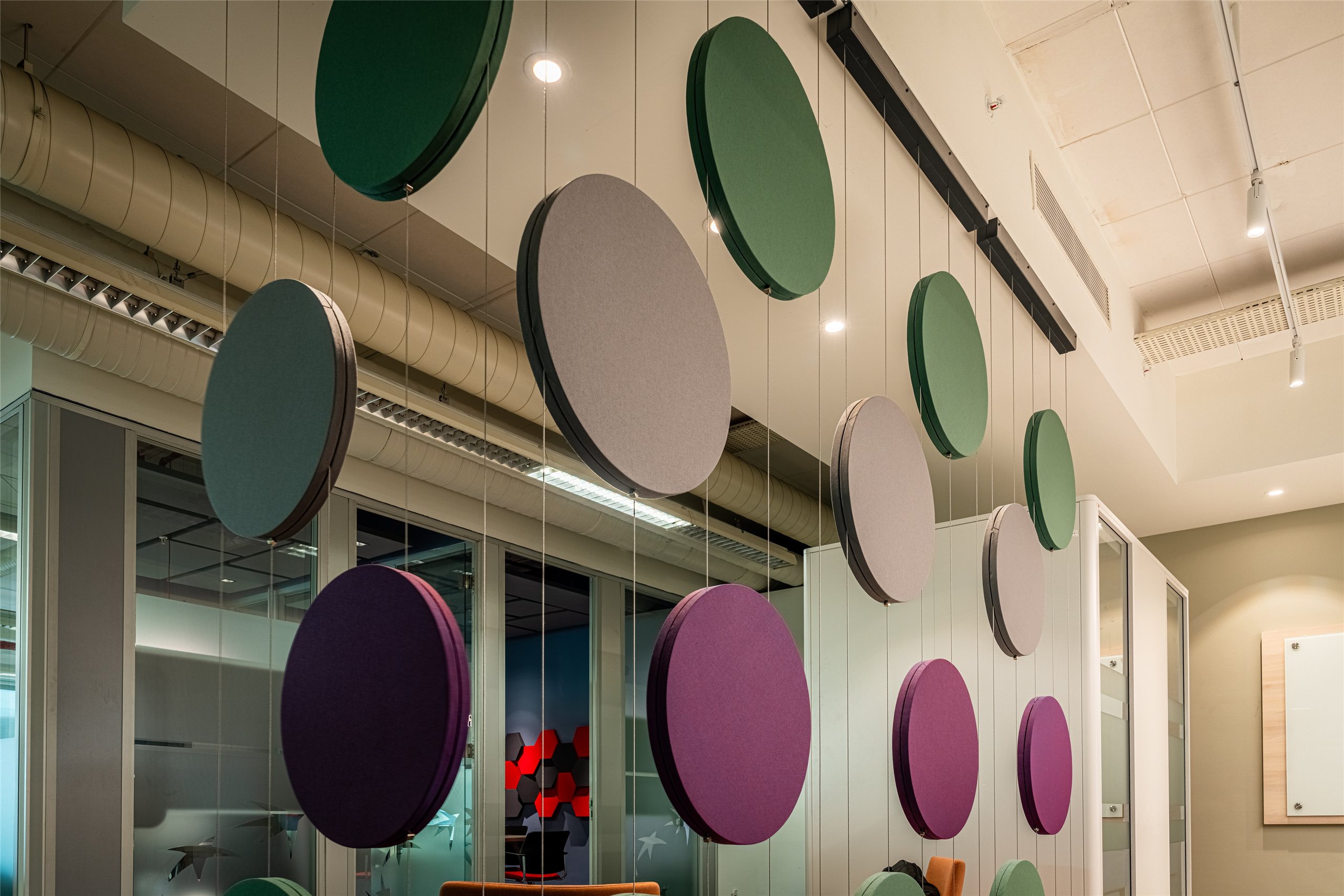

Acoustic wall panels are the product most people picture when they hear acoustic treatment, and the one most often bought for the wrong job. A panel absorbs the sound that hits it instead of bouncing it back into the room. That shortens the echo and makes speech easier to follow. It does not stop sound travelling through a wall to the room next door. If you keep one thing from this guide, keep that.
What a wall panel actually does to sound
Most panels are a porous core, usually mineral wool, PET felt or foam, behind a fabric or felt face. Sound enters the material, the air inside the fibres is forced to move, and the energy turns into a very small amount of heat. What comes back into the room is quieter. Add enough of that across a room and the reverberation time drops, which is the measurement that decides whether a space feels clear or muddy. We explain that number in our guide to reverberation time (RT60).
Panels work best on the mid and high frequencies, which is where speech, laughter and cutlery live. That is why they are so effective in offices, classrooms and meeting rooms, and why they do less for the low rumble of traffic or plant.
Where wall panels work best
- Meeting rooms and video call rooms: panels behind and beside the camera stop the echo the microphone picks up. See our meeting room and conferencing room pages.
- Offices with hard, glazed walls: one or two well-placed walls of panels often do more than a scatter of small ones. See offices.
- Restaurants, cafes and reception areas: where the ceiling can't be touched, or where a feature wall doubles as branding.
- Rooms with two hard, parallel walls: treating one of them stops the fast buzzing repeat known as flutter echo (see our flutter echo guide).
The advantages, plainly
- It is the simplest retrofit. No ceiling works and no services to move.
- The range of finishes is wide, from panels that disappear into the wall colour to bold printed or colour-blocked features.
- You can aim the treatment. If the problem is the wall behind a presenter, you treat that wall.
- Absorption is measured and published, so you can compare products on evidence rather than photos.
The limits you should know before you order
- A panel only treats the area it covers. In a tall or large room, walls alone rarely reach the reverberation target, and the ceiling is usually the bigger opportunity. See acoustic ceilings: tiles, baffles or rafts.
- It is not soundproofing. If you can hear the next room, you need insulation in the wall, not panels on it. We cover the difference in soundproofing vs acoustic treatment.
- Thin panels do little in the low frequencies. If bass or plant noise is the complaint, ask about thicker panels or an air gap behind them.
- Fabric faces can fade in strong sunlight, and low panels in corridors get knocked. Choose the face for the room, not the brochure.
How panels compare with the alternatives
| Option | Best for | Trade-off |
|---|---|---|
| Wall panels | Targeted fixes, feature walls, meeting rooms | Limited by available wall area |
| Ceiling baffles | Tall rooms, open-plan floors, canteens | Visible overhead, need clear ceiling void |
| Stretched fabric | Large, seamless walls and printed graphics | Higher installed cost, frame system |
| PET felt panels | Colour, texture, recycled content | Slightly lower peak absorption than mineral wool |
What to ask a supplier before you commit
- The absorption class. Under BS EN ISO 11654, Class A means a weighted absorption coefficient (αw) of 0.90 or above. Ask for the class and the actual test report, not just a headline number.
- Thickness and how it was tested. A 25 mm panel and a 50 mm panel behave differently, and the mounting used in the lab affects the result.
- Fire performance. Class 0 alone no longer satisfies building control on new work. Ask for the Euroclass rating. Our fire ratings guide explains what to look for.
- Fixing method. Adhesive or mechanical, and whether it suits your wall, plasterboard, block or concrete.
- How many you need. Coverage should be calculated from your room volume and reverberation time, not a rule of thumb.
Common questions
What NRC or absorption class should I look for? It depends on the room. A busy open-plan floor needs more absorption than a small meeting room. We calculate it in the survey rather than quoting one rating for every space.
Can panels be almost invisible? Yes. They can be finished to match the wall, or specified as a deliberate feature. Both are common.
How do I know how many panels I need? From the room volume and the existing reverberation time. That is what a proper survey assesses.
Get the quantity right before you order
Buying panels by the square metre without a clear target is how rooms end up half treated. Book a free acoustic survey and we'll assess the room and give you a quotation, or browse our acoustic panels range.
From first survey to final finish
Seven stages, one point of contact. Book a free survey or call +44 1908 880191, and we'll come back to you with the next step.

An acoustician visits the site, or works from your drawings and photos when a visit isn't practical. Either way, the room, its surfaces and how it is used are recorded before any advice is given.

Reverberation, ambient noise and noise transfer are read against what the space is used for. The findings arrive as an AI-assisted acoustic report with recommendations, yours to keep with no obligation to proceed.

Treatment is modelled against a reverberation target, then drawn up with panel positions, fixings and finishes. Nothing moves forward until you have approved the design.

Every quotation comes with the specification behind it, listing products by type, quantity and finish with costs set out line by line. What is quoted is what the design calls for.

Panels, baffles, ceilings and screens come from the manufacturers we work with and are supplied to the approved specification. What arrives on site matches what was designed.

Our installation team fits to the approved drawings, checking positions and fixings as they go. One team supplies and installs the treatment.

Optional paid add-on: after fit-out the space can be measured again and compared with the original survey, so the improvement is measured rather than assumed. Compliance testing is carried out with our testing partner, EMC Acoustics, and the written record goes into your building file.
Stay connected with insights
Get the latest updates from our acousticians