
Micro-perforated Acoustic Panels: Solid Look, Real Absorption
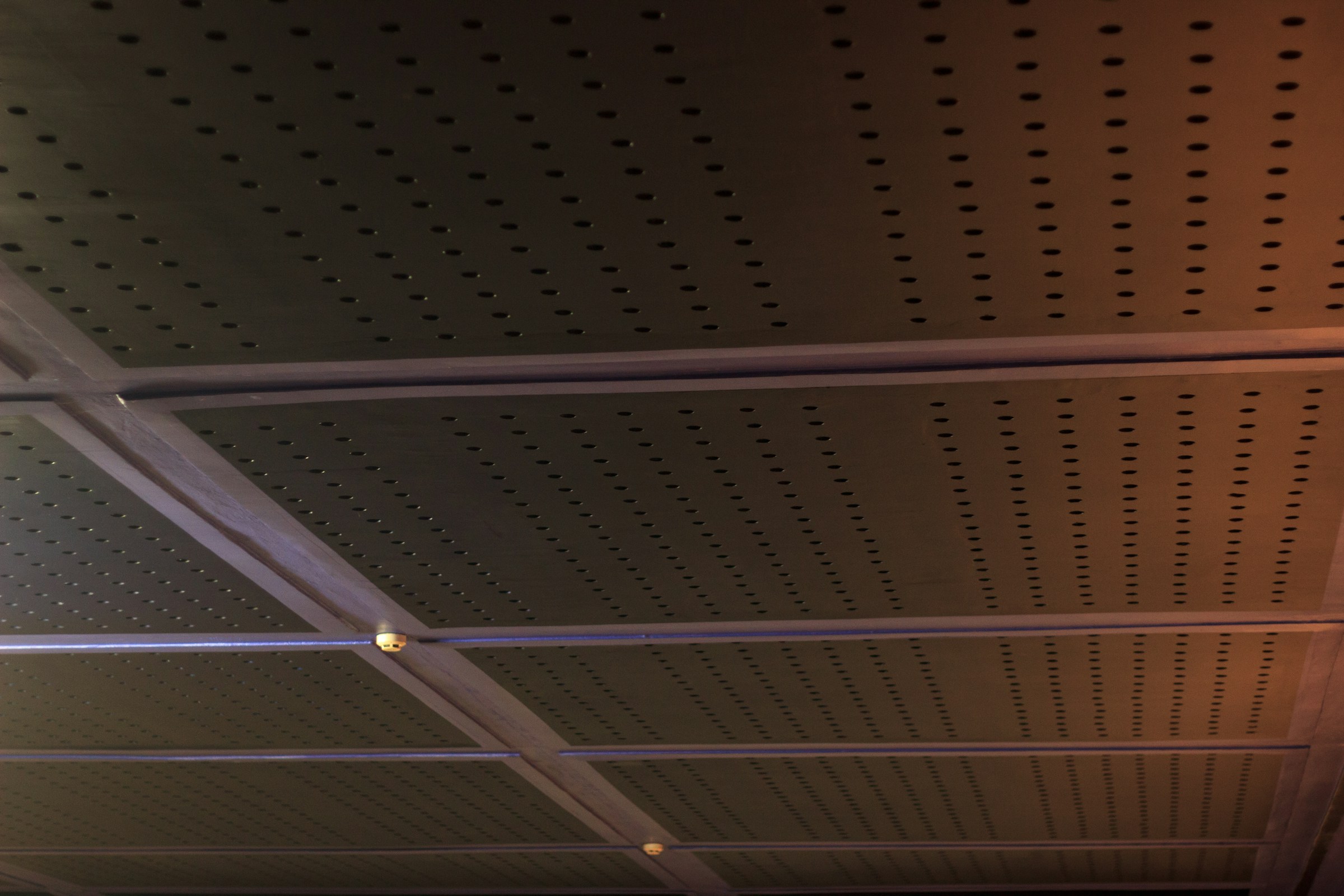

Micro-perforated acoustic panels have thousands of very small holes across a wood, metal or laminate face. At normal viewing distance, the surface looks solid. Behind it sits an air gap and usually an absorbent layer, and the tiny holes let sound into that space where it loses energy. You get real acoustic performance from a surface that doesn't look like an acoustic product at all.
How microperforation works
Each hole is around a millimetre or less across. That is small enough that air moving through it meets real resistance, and the air trapped behind acts like a spring, so the combination absorbs sound energy at frequencies set by the hole size, hole spacing and the depth of the air gap. Change any of those and you change which frequencies are absorbed. That tunability is the main difference from an ordinary perforated board, where holes are decorative and larger.
Where micro-perforated panels are the right choice
- Healthcare corridors and clinical areas: smooth, durable, cleanable faces without fabric. See healthcare.
- Corridors and circulation: where visible acoustic panels aren't part of the brief. See circulation areas.
- Prestige interiors: lobbies, boardrooms and museums where a visible panel would spoil the finish.
The advantages
- The finish reads as solid wood, metal or laminate, and you can perforate the finish you actually want.
- Tunable to a defined frequency target, which suits projects with a reverberation goal.
- Durable, wipeable faces, and no loose fibres in the visible surface.
- Near-invisible treatment where the brief says acoustics shouldn't be seen.
The limits and traps
- Absorption is more tuned and often narrower in bandwidth than a fibrous panel, unless an absorbent layer is added behind. It works best when it's designed for a specific problem, not dropped in as a generic panel.
- It needs an air gap and an absorbent layer behind the face. The mounting depends on the wall build-up, so it can't always be fixed flat.
- Repainting on site can clog the perforations. A coat of paint that looks fine can seal thousands of holes and destroy the performance. Finish the panels once, in the factory.
- The holes are visible on close inspection. Ask for a physical sample before you decide.
- It usually costs more than a standard panel of the same area.
Micro-perforated vs the other options
| Micro-perforated | Perforated or grooved wood | Fabric panel | |
|---|---|---|---|
| Hole or opening | Very fine, nearly invisible | Larger, visible pattern | Open weave |
| Absorption | Tuned to a frequency range | Set by open area and backing | Broad, mid to high |
| Look | Solid, seamless | Visible pattern | Fabric face |
See acoustic wood panels for the visible-pattern option.
What to ask before you order
- Hole diameter, spacing and open area, and the tested absorption with the exact backing and air gap.
- The mounting build-up your wall needs.
- Face material and its Euroclass fire rating.
- Factory finishing, so nobody paints over it on site.
- A physical sample, so you can see the holes at close range.
Common questions
How is it different from a normal perforated panel? The perforation is engineered. Hole size, spacing and the air gap are calculated to tune absorption to a frequency range.
Will the perforation be visible? Not at normal distance, but it shows up close.
Is it suitable for healthcare? Yes, it is a common choice for corridors and clinical spaces.
Design it against a target, not a catalogue page
Micro-perforated panels reward proper design. Talk to an acoustician or see micro-perforated panels.
From first survey to final finish
Seven stages, one point of contact. Book a free survey or call +44 1908 880191, and we'll come back to you with the next step.

An acoustician visits the site, or works from your drawings and photos when a visit isn't practical. Either way, the room, its surfaces and how it is used are recorded before any advice is given.

Reverberation, ambient noise and noise transfer are read against what the space is used for. The findings arrive as an AI-assisted acoustic report with recommendations, yours to keep with no obligation to proceed.

Treatment is modelled against a reverberation target, then drawn up with panel positions, fixings and finishes. Nothing moves forward until you have approved the design.

Every quotation comes with the specification behind it, listing products by type, quantity and finish with costs set out line by line. What is quoted is what the design calls for.

Panels, baffles, ceilings and screens come from the manufacturers we work with and are supplied to the approved specification. What arrives on site matches what was designed.

Our installation team fits to the approved drawings, checking positions and fixings as they go. One team supplies and installs the treatment.

Optional paid add-on: after fit-out the space can be measured again and compared with the original survey, so the improvement is measured rather than assumed. Compliance testing is carried out with our testing partner, EMC Acoustics, and the written record goes into your building file.
Stay connected with insights
Get the latest updates from our acousticians