
3D Acoustic Panels: Sculptural Walls That Also Absorb
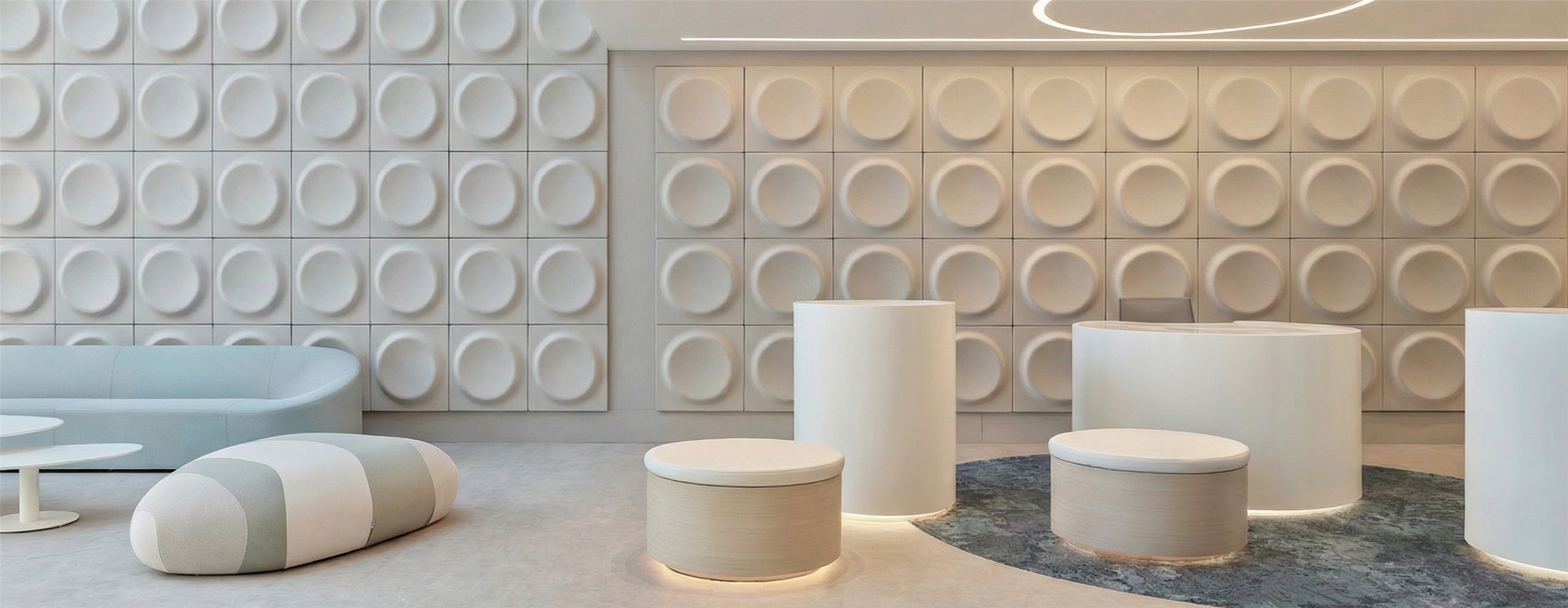

Textured and 3D acoustic panels have a sculpted surface: folds, waves, pyramids or faceted shapes instead of a flat face. The relief does two jobs. It gives a wall real architectural depth, and it scatters sound as well as absorbing it. If you want a feature wall that looks designed and keeps a room sounding lively instead of dead, this is the category to compare against flat panels.
How the surface geometry helps
A flat panel absorbs and reflects in one direction. A 3D surface has many angled faces, so the sound that isn't absorbed is thrown in different directions instead of returning as one clear reflection. That scattering is called diffusion. Its value is that a room keeps some life and openness, where a room covered with only flat absorbers can feel dull and boxed in. We explain the trade-off in absorption vs diffusion.
Where 3D panels work best
- Cinemas and auditoriums: where you want to avoid both echo and a flat, dead sound. See auditoriums and theatres.
- Premium retail and showrooms: where the wall is part of the brand. See showrooms.
- Receptions, restaurants and hotel lobbies: where a plain panel would look like equipment.
- Large accent walls: the relief hides minor joints and surface imperfections better than a flat panel.
The advantages
- Diffusion and absorption in one surface, which helps a room sound natural.
- Light rakes across the relief through the day, so the wall looks different at different times.
- More forgiving of an uneven wall or a visible joint than a flat finish.
- A strong design feature without extra decoration.
The limits
- Absorption is pattern-specific. Two 3D panels can look similar and absorb quite differently. Check the test report for the exact pattern and thickness you are buying, not a general claim about the range.
- The acoustic benefit is limited to the area covered. A single feature wall helps locally, and it may need balancing with ceiling or other wall treatment.
- The raised surface collects slightly more dust than a flat one. An occasional light vacuum is enough.
- They usually cost more than flat panels of the same area, so use them where the look is worth it.
3D panels vs flat panels
| 3D panels | Flat panels | |
|---|---|---|
| Sound | Absorb and scatter | Mainly absorb |
| Look | Sculptural, changes with light | Clean, can disappear into the wall |
| Best for | Feature walls, performance spaces | General echo control, meeting rooms |
| Cost | Higher | Lower |
See our acoustic wall panels guide for the flat option.
What to ask before you order
- The absorption test report for the exact pattern and depth.
- The material behind the surface, and its Euroclass fire rating.
- How joints and corners are handled on a large wall.
- A sample under your actual lighting.
Common questions
Do 3D panels absorb more than flat panels, or is it visual? Both. The geometry scatters sound as well as absorbing it, so diffusion is genuinely improved.
Will the pattern look different in different light? Yes, which is part of the appeal. View a sample where possible under the room's own lighting.
Can they hide an imperfect wall? To some extent, yes.
Choose the pattern with the acoustics in mind
A beautiful pattern with weak absorption is a poor buy. Book a free survey and we will match pattern to target, or see textured and 3D acoustic panels.
From first survey to final finish
Seven stages, one point of contact. Book a free survey or call +44 1908 880191, and we'll come back to you with the next step.

An acoustician visits the site, or works from your drawings and photos when a visit isn't practical. Either way, the room, its surfaces and how it is used are recorded before any advice is given.

Reverberation, ambient noise and noise transfer are read against what the space is used for. The findings arrive as an AI-assisted acoustic report with recommendations, yours to keep with no obligation to proceed.

Treatment is modelled against a reverberation target, then drawn up with panel positions, fixings and finishes. Nothing moves forward until you have approved the design.

Every quotation comes with the specification behind it, listing products by type, quantity and finish with costs set out line by line. What is quoted is what the design calls for.

Panels, baffles, ceilings and screens come from the manufacturers we work with and are supplied to the approved specification. What arrives on site matches what was designed.

Our installation team fits to the approved drawings, checking positions and fixings as they go. One team supplies and installs the treatment.

Optional paid add-on: after fit-out the space can be measured again and compared with the original survey, so the improvement is measured rather than assumed. Compliance testing is carried out with our testing partner, EMC Acoustics, and the written record goes into your building file.
Stay connected with insights
Get the latest updates from our acousticians