Classroom
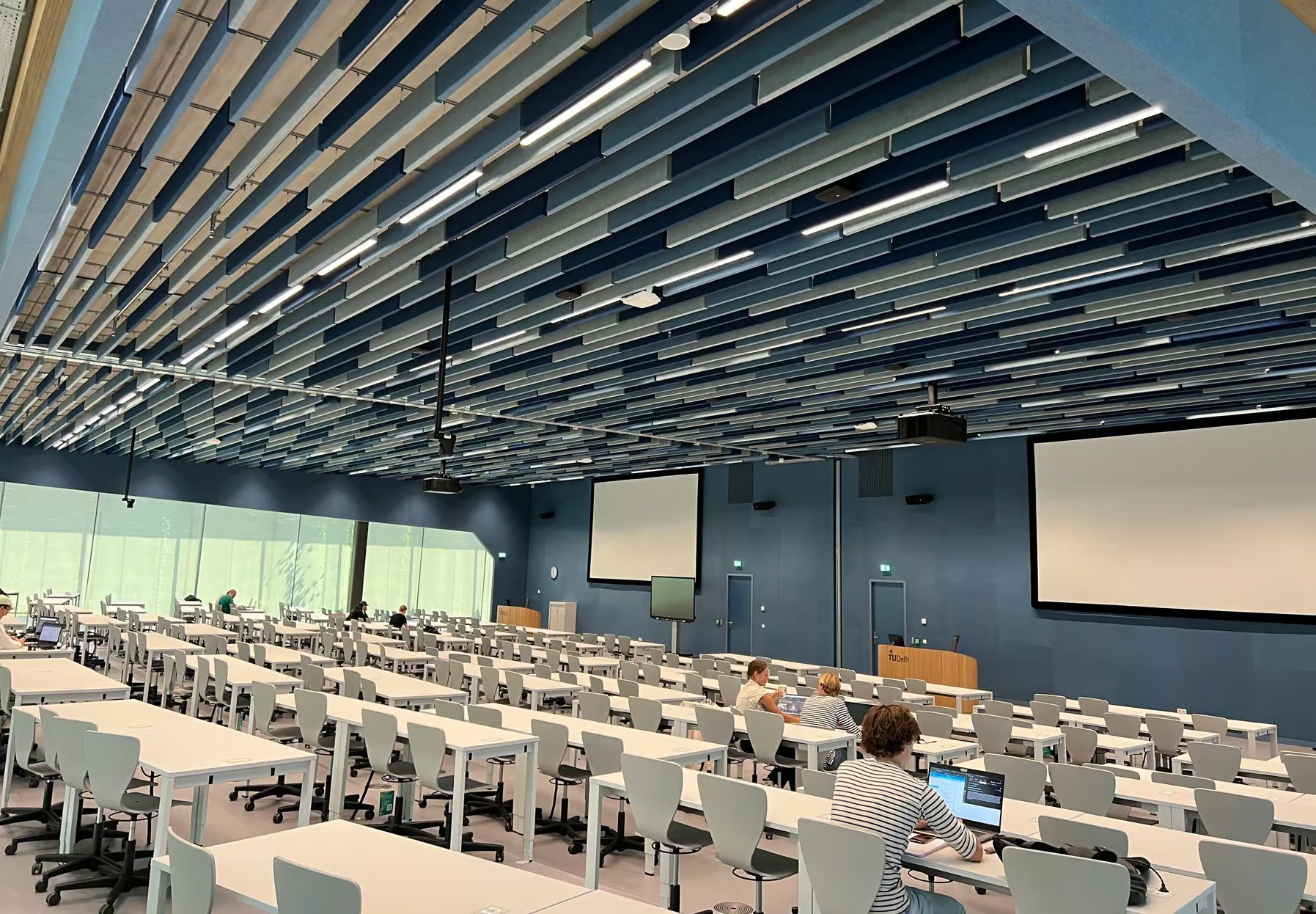

Pupils hear the teacher clearly from the back row

Specified to Building Bulletin 93 reverberation targets

Less vocal strain for teachers

Supports pupils with hearing or attention needs
Untreated classrooms blur the teacher's voice
The right treatment fixes this properly, not by guesswork. By absorbing sound at the ceiling and upper walls to BB93's reverberation targets, you bring the room down to a level where every pupil can actually follow the lesson — not just the ones sitting closest to the front.
In an untreated classroom, a teacher's voice doesn't just carry — it smears, bouncing off hard walls and ceilings until words blur together by the back row. Children strain to follow, and the ones already struggling — because of a hearing difference, or because English isn't their first language — fall behind fastest. It's serious enough that BB93 sets a legal reverberation limit specifically to stop it happening.
Custom acoustic solutions for
Classroom

Sound reasons for Acoustic

One contractor, start to finish
Survey, design and installation handled by our own team, and testing carried out with our testing partner, EMC Acoustics. One team stays accountable for the result, from the first site visit to the final sign-off.

Designed to a target
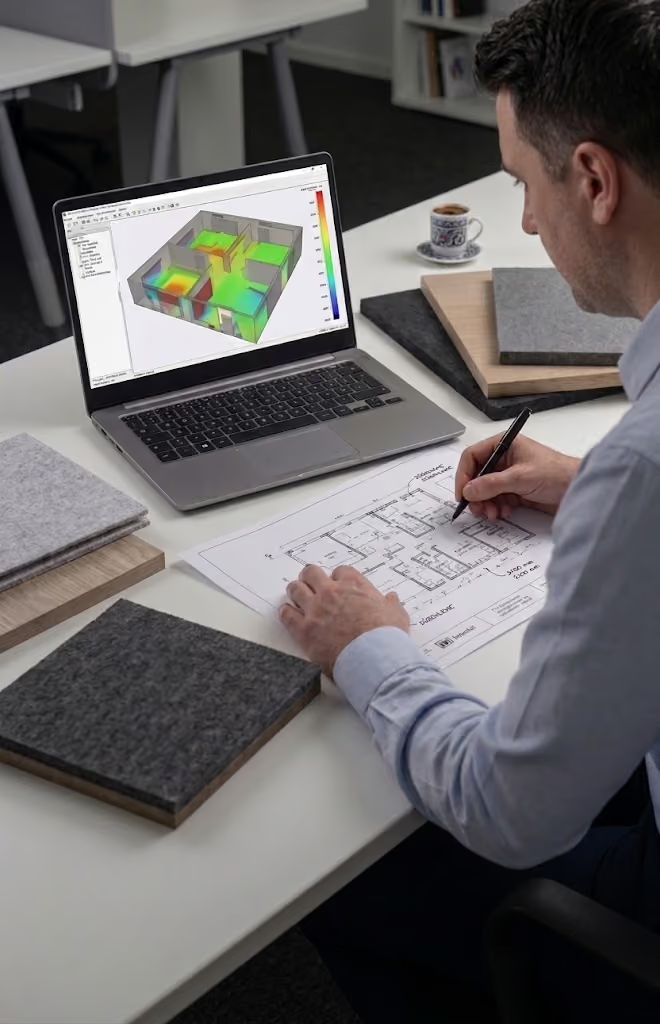
Every space gets an acoustic design modelled to a specific reverberation target, not a standard panel layout. Before-and-after acoustic measurement is available as a paid add-on, so the improvement can be proven, not just felt.

Designed to meet BB93
Research in London primary schools linked classroom noise to lower test results, and pupils with hearing, language or attention needs are more sensitive still. We treat each classroom to its BB93 reverberation target, so speech stays clear from front to back and teachers don't have to compete with the room.

Independent on materials
We source from several manufacturers and are tied to none, so we specify what your space and budget actually need, not what one catalogue stocks.
What We Offer
Classroom
Not sure what this space needs? Call us on +44 1908 880191 or book a free survey, and we'll come back to you with the next step.

We assess each classroom against the BB93 targets, including speech intelligibility between groups in open-plan teaching areas, design ceiling and wall absorption to suit, and specify the products. Our installation team plans the work around the school timetable. Compliance testing with our partner EMC Acoustics can be added as a paid service.

A free site survey. An acoustician assesses the space and how it is used, and you receive a quotation and an AI-assisted acoustic report, with no obligation to go ahead.
Product placement, specifications and drawings your contractor can work from, designed around how the space is used. Free design on qualifying projects.

Send us drawings and photographs and we'll prepare an acoustic proposal with product recommendations and a quotation for supply and installation, free of charge.
Before-and-after acoustic measurement and compliance testing, carried out with our testing partner EMC Acoustics. This is a paid service, available on any project.
Trusted on schools, venues and landmark halls








How we reduce the noise
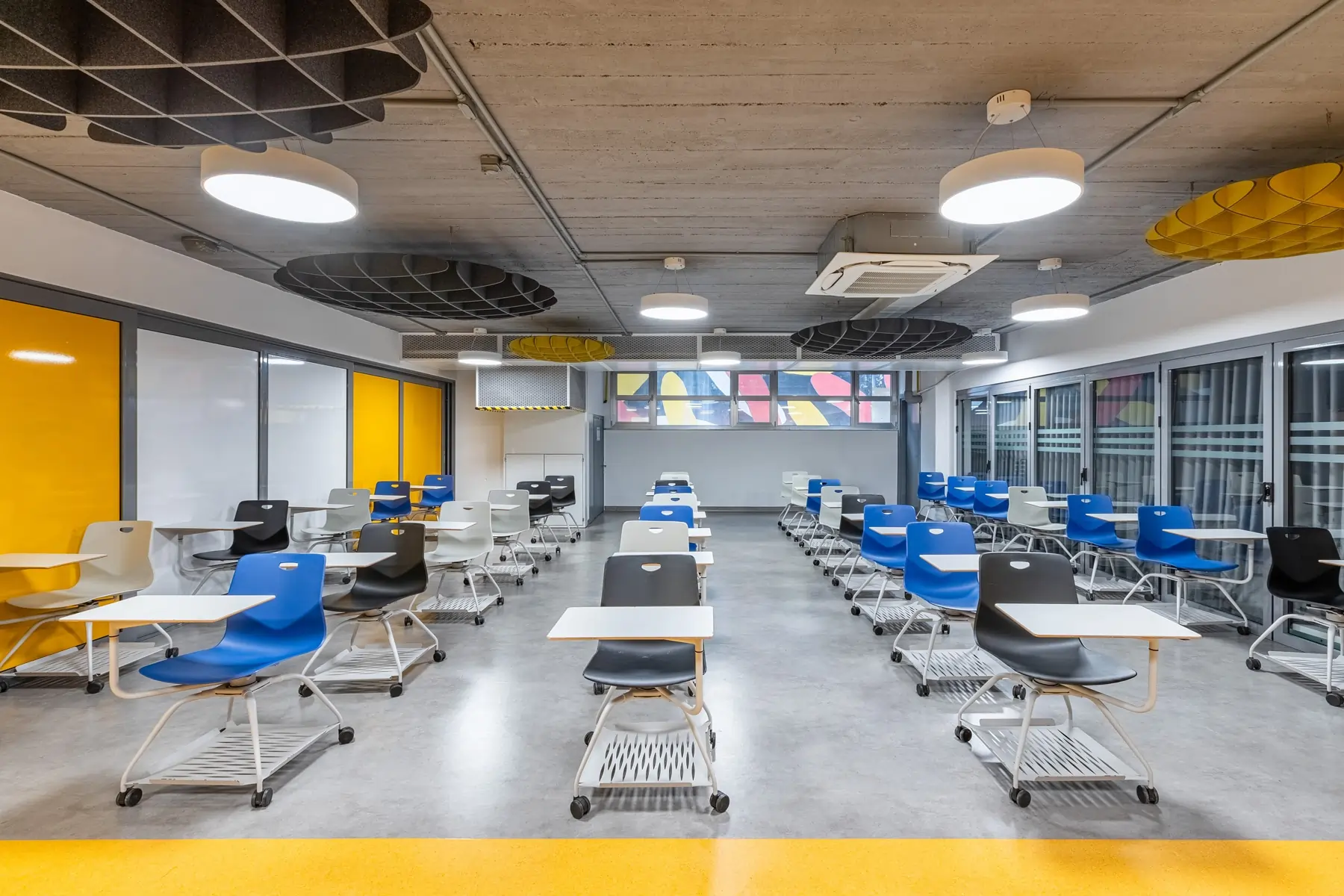
We treat the ceiling and upper walls with panels rated for the reverberation time BB93 requires for teaching spaces, using impact-resistant finishes that are built to survive daily classroom use.
One team surveys, designs and installs — nothing gets lost between contractors
Every install is checked against the target spec before we call it done
Not tied to one manufacturer, so the product is chosen for your space, not our stock
Standards, finishes and installation
Your questions about this space, answered.
Generally around 0.6 to 0.8 seconds for a general teaching space, depending on the room's volume and type, and about 0.4 seconds for rooms used by pupils with hearing impairment or SEN. We calculate your room's target from its volume and use, then specify treatment to reach it.
Yes. Lower reverberation makes speech clearer for every pupil, and it helps most those with hearing difficulties or English as an additional language, who struggle first when reflections blur a teacher's voice. It also reduces vocal strain for staff.
We usually schedule installation for school holidays or after hours to avoid disrupting lessons. For a single room, a weekend or a short closure can work. Dust, noise and access are agreed with the school in advance.
Impact-resistant panels, fixed above pupil reach or with tougher facings at lower level. Fabric-wrapped panels at pupil height are easily damaged, so we place absorption on the ceiling and upper walls and choose durable finishes below.
Post-installation testing is available as a paid add-on, carried out with our testing partner, EMC Acoustics. It measures the room's reverberation time against the target, and we give you the results in writing. Keep the report with your school's building records, because it evidences how the room performs.
Too noisy? Let's talk silence.
Book a FREE site survey, and an acoustician will tell you exactly what your space needs. Rather talk first? Call +44 1908 880191.